
Subtle care makes a stark difference
Being intentional inn everything I do
Steve at RestoVivaldi put out a great video today on how to make an Italian sub sandwich and it really made me think about the nuances that can make such a big difference. In particular, he talks about how he prefers his cold cuts to be shaved (wafer thin) which I absolutely agree with. Another element that he didn’t mention but I’ve noticed makes a big difference is how you mechanically layer the meat on the sandwich. If you fold the layers of meat or even just pull them apart and rearrange them as you build your sandwich the difference is incredible. The extra layers of air make a dramatic difference in flavor. This is similar to slurping soups or drinks.
Why do I bring this up? Because ‘How you do the little things is how you do everything’. That attention to detail and the striving to make your work that much better is how I improve my art. It’s not just about getting reps in. Progress is about intentionally trying to drive your craft forward. I make a great cup of coffee or a perfect ice cream cone largely because I care to do so. Sometimes it doesn’t work out. But I always am aiming for perfection. In an art context it may be how you hold your pencil, how much pressure you put down, or which ink do you use.
Pentel brush pens feeds ink relatively slow. You have to move slowly if you want thick bold lines. Alternatively, you can use a Pentel pocket brush that feeds ink much quicker. But, is rushing through your drawing helping you? What could you gain from slowing down, even just a little bit. What extra flavor can you bring with a slow feeding pen? What about if instead of feeling lines with your pencil, you make bold confident marks? You have to change your way of thinking. Then you take a step back and ask yourself, is this bringing me closer to the kind of art I want to create?
I had a martial arts instructor that would tell us, “practice doesn’t make perfect. Perfect practice makes perfect.” With the hustle of everyday life it’s too easy for me to forget to take my time. If I don’t get the effect I’m looking for I doesn’t matter. The added benefit of taking my time is that I find those little nuances that make all the difference.
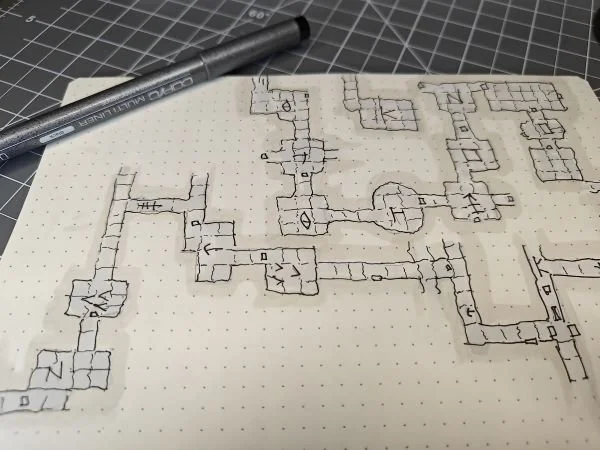
Four Against Darkness dungeon
Ryan
Structure your work
Why I pause before working
I mentioned in a previous post that one of my all time favorite quotes is from Martin Luther, “I've got so much work to do today, I'd better spend two hours in prayer instead of one.” I may disagree with him theologically, but he really hit the nail on the head with that one.
In my working life I’ve commonly worked with people that could aptly be described as frantic. My first job was at a coffee shop. On busy days,, the assistant manager would frequently look at me during rushes in bewilderment because I wasn’t panicking. “There’s a line of drinks to be made!” she would shout at me. This was also the case in my last role. I had a vendor that reported to me that would refuse to meet with me for weeks on end. “I don’t have time,” she would say as the deadlines raced towards us, and on occasion past us.
With all that said, structure is always an on-going battle for me. It’s easy to start a new structure, but it just takes one or two speed bumps to throw me off sometimes. When I got my first 9-5, I would use 3×5 sticky notes. This was a giant leap forward for my productivity. I tend to be a person that takes far too many notes. This really helps my memory but can be a chore to dig through, even if you take notes digitally. By distilling out what I need to do in a day with sticky notes I get the best of both worlds.
The problem came when I started working on more than one project at a time. My sticky notes became top priorities. Items soon started to carry from day to day and the system fell apart. I still love sticky notes even with their flaws. I should mention though, if you have waist-high children, you probably want to keep them out of arms reach (this includes when they are on your lap).
The importance of structure is not just looking forwards but also looking backwards. I don’t just want to know what I need to do. I want to see how much I have done. Have I been slacking? Am I crushing it? Is there some task that is devouring me week? My latest strategy is to keep a logbook. I got this from Austin Kleon’s book Steal Like an Artist. Now I have a tidy list day by day of everything I did. Sometimes it pushes me to get more done so I have something to write. Other times I a boost as I get write down just how productive my day was. At some point soon when I stop wearing 20 hats, it will hopefully be helpful with fine tuning my daily rhythms letting me be more productive. But maybe I’m just getting ahead of myself.
Ryan
A scripted life
The striking difference between video and literature
Life has a way of working in circles. I’m not sure if it’s just because I live a life of hyper-focus cycles or if that’s how life is for everyone else too, but sooner or later I end up doing all of the things I did in a past life. Perhaps it further exemplifies who I truly am as a person. Or perhaps it’s just the tug of my ever-expanding list of hobbies, much to the dismay of my wife.
I spent this evening hammering out a script for a promo video for new venture of mine. As I was working it brought memories rushing back of every exciting moment I spent on a stage, on camera, or writing scripts. I’ve never been much of an actor. but I did spend a decent bit of time in the drama department of my high school and college. And before that I made a few videos for school projects. It was never anything super serious, and I never got any accolades, but it sure was a blast. I’m sure it was extra exciting for my scene partners as I struggled to remember lines.
There’s something different about how you much can capture physicality and energy in a script as compared to in poetry and fiction. With literary art where the end goal is the literature, I get sucked into words. At times I marvel at the language. “Boy that’s a clever sentence,” I think to myself. This is of course before I delete It for being distracting or not moving the story forward. Which makes sense. I do have a degree in Linguistics, and the way I got there was falling love with the beauty of language. But script writing doesn’t have any of that. The goal is not for it to be beautiful on the page, but in front of your eyes. It also doesn’t require the writer to think of clever ways to convey information that would be obvious to someone viewing the situation. This is a critical difference
One of my favorite examples of this difference between the book Fear and Loathing in Las Vegas by Hunter S. Thompson and the Movie. You may be familiar with the scene towards the end of the movie where Hunter is pulled over for drunk driving. When you watch the movie (which I saw first), you can see how Hunter is acting and that as he is spinning a wild story of why he was driving the way he was and that he is clearly holding a beer can in his hand. In the book, this information is only revealed at the end of Hunter’s story. The tension created by the situation and then the explosive release as you find out that it was all for not is incredible. I can’t say I’ve ever read another writer that achieved such a setup and delivery.
Ryan
A change in the wind
Sometimes chapters change when we least expect it
A few months ago I was sitting in a class and one of the staff members read a poem she had written. Not only did the words move me, but it re-awakened my love of poetry. The most interesting part is that this poem was not part of the agenda, and this wasn’t a writing classic, or even some other type of art class. This awakened something inside of me. I’ve never been a prolific poetry writer, but I did write a handful of poems in college. It is a part of my life I had forgotten about.
Recently, there was some bad news in my community that created quite a bit of distress. I’m not going to dive into details on the specific event that happened, but instead cover some of the realizations that came to me in the aftermath.
As a writer it is very easy to exercise control. I choose when are where chapters start and end. Real life is not like that. Real life tends to revolve around the unexpected rearing its ugly had and turning everything upside down. But there is always a silver lining. Always.
By finding the silver linings in life we grow as people. We become more understanding. We become more thankful. We gain perspective. Sometimes our faith is shaken. “Am I going down the right path?” we ask ourselves. This isn’t always clear — especially not in the moment.
For the first time in nearly 15 years, I wrote a poem.
Sometimes the world is turned upside down
Sometimes this is an illusion
Sometimes life fragments into chaos
Sometimes chaos is order
Sometimes we are hindered in our quest for righteousness
Sometimes what is right cannot be done
Sometimes the path in front of us is a labyrinth
Sometimes our eyes are open but we cannot see
Sometimes a gift appears in front of us
Sometimes what we feel must not be
Sometimes what has always been still is
Sometimes the soul’s tug is relentless
In life there is always time
The end of a chapter can be very scary, especially when it happens suddenly. But the good news is, a new chapter always starts.
Ryan
Being lazy solves problems
Laziness can sometimes be a superpower
“I choose a lazy person to do a hard job. Because a lazy person will find an easy way to do it.” This quote is often attributed to Bill Gates, but apparently it is from Frank Gilbreth Sr..
For better or for worse, I commonly am that person. About 6 years ago I worked on a migration at Microsoft. I was brought on board as someone just to do some mechanical moving of files, though curiously with the added requirement of some SQL knowledge.
The big problem? Edge cases. A project as large as this turns out to have a surprising number of edge cases. This combined with my laziness quickly began to tug on me after joining the team. For example, from time to time we would need to make a single update for one set of documentation but across 11 languages. The annoying part was that each language had to be synced manually. There was no way I was going to navigate through all 11 directories just to sync the content. The solution? Write a 10-line script that did it for me.
That brings us to today. I’m trying to stir up some new clients for a video company I’m working on, but first I need to build a portfolio. I do have existing work in a similar format, but it is in a different niche. Plus, it always looks just a little tacky if your portfolio is all videos of yourself.
Luckily, YouTube is full of people that will, at least hopefully, be happy to let me cut them free videos if I can also use them in my portfolio. After about 15 minutes of digging through YouTube search results, I realize I’ve underestimated the amount of chaff I’m going to need to winnow.
What if I were to build some automation to do the digging for me? Better yet, what if I were to have AI write the code to do the automation for me? Well, that’s exactly what I did. Within a few minutes I had a Python script that could dig through YouTube, filter and the add the results to the bottom of a google sheet. With a couple more iterations, I’m filtering on more dimensions and removing more chaff automatically. Now, I can rapid fire pull results from multiple search terms and move on to qualifying the leads. What was a process that looked more like can of worms with unpredictable ROI, is now a very predictable 2-hour block that produces results.
The moral of the story? To solve a problem, you first need to clearly articulate it, then start testing strategies. Use your laziness as fuel. There is an odd truth in my life that I would much rather spend 2 hours automating something annoying than to just do what is annoying if it takes 1 hour.
And with that I will end this post with one of my other favorite quote, from an unlikely source.
"I have so much to do that I shall spend the first three hours in prayer” - Martin Luther
Ryan
Stop making art
Sometimes the best way to move forward is to stop
I, like most people, want to be a better artist. And it can be easy to fall into the trap of just getting the reps in. “If I just do gesture drawing for 15 minutes a day, I’ll become a world class artist.” This seems reasonable and actionable. I go to my favorite gesture website, hit go, rinse and repeat.
Therein lies the rub: Unless you are intentionally working on a skill and pushing your limits, the same exercise everyday at best will make you stand still. No jacked guy at the gym has ever attributed his success to doing the same set x reps x weight for 6 months without at least improving technique. It doesn’t make sense in the gym, and it doesn’t make sense for art.
If you are just spinning your wheels, stop what you are doing. Take some time off if you need to. I’ve played guitar for almost 25 years. As a beginner the only thing I wanted to do was to be able to play solos like Slash off the top of my head. The advice I heard was to learn the pentatonic and blues scales and do figure exercises. And that’s what I did for years. Can you guess what happened? I got reasonably good at going up and down the scale. No solos, no blues. I become okay at playing scales.
As my interest in playing guitar came and went, I would take breaks. And as if by magic, when I came to guitar in college after a year or two off, something magical happened. I could improvise and play a passable solo! Not from playing every day. Not from exercises and drills. But from taking time off and coming back to the guitar with fresh eyes. You won’t catch me playing Madison Square Garden anytime soon, but progress is progress.
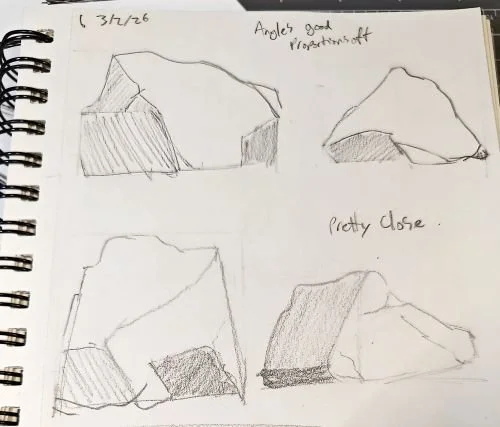
Day 1 - Rocks looking like random scribbles
The second most important thing in art is to have fun, not the first. The most important thing in art is to get better. This could be technique, narrative, composition, or anything that materially improves your art. Conveniently, watching yourself get better at art makes it fun.
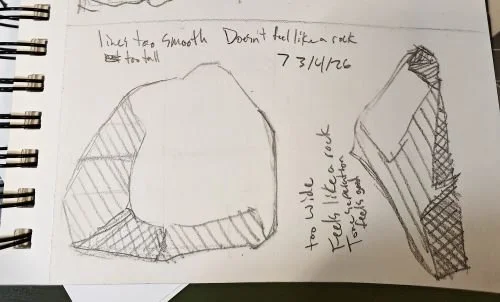
Day 2 - Rocks starting to look like rocks
Don’t stress, pick something small, and move the needle. Most importantly, look for you victories.
Ryan
Which road to take
I’ve always been good at brainstorming. Maybe too good at brainstorming.
I’ve always been good at brainstorming. Maybe too good at brainstorming.
Currently I’m working on two different creative ventures, and while both are creature they operate on very different business models. On one hand I need to actually have a clear business plan, target specific customers, sell value prop, and the list goes on.
On the other hand I am making ‘real art’. Building RPG content. Illustrations. Writing fiction. These endeavors thrive on the end product. They to an extent sell themselves. But that doesn’t mean there aren’t choices to be made.
Success requires focus. Not just while you are working, but in what you produce. It does me no good to one day make a caricature, the next day ink a comic page, and the third day make an abstract watercolor painting.
One strategy I’ve adopted to at least temper what some might call analysis paralysis, or what others might call procrastination is to have something daily that is easy to force myself to do and is to an extent mechanical. What is something I can do that reliably moves the needle but doesn’t require high level decision making? What is something that forces me to at least grow a little bit?
False-exercise is the enemy. In the past I’ve done daily gesture drawing. This felt great at first but within a couple days my progress stalled. I pushed on with the false hope that I will eventually get better, just through reps alone. This is not the case. I wouldn’t expect the exact same set in the gym to help me grow, why would it be different for any other skill? The real difference is in perception. You know when a set in the gym is hard and is pushing or limits or is wildly easy. But with are we just want to have fun. Fun is fun, but more often than not it doesn’t push us forward.
The trick is finding a daily exercise that is moderately challenging, and changing it before it gets stale.
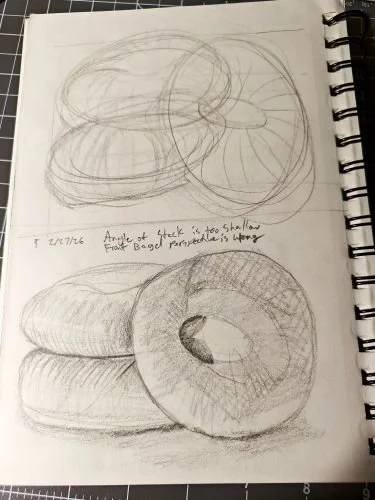
As I ponder what my future life should look like I’ll leave you with my current solution to moving the needle: Drawing from reference followed but noted critiques.
Ryan